News
Large Scale Mold Manufacturing: The Ultimate Guide to Engineering Giant Molds
Large Scale Mold Manufacturing: The Ultimate Guide to Engineering Giant Molds
Table of Contents
Introduction
Large Scale Mold Manufacturing is where heavy industry meets ultra-precision engineering. In the world of injection molding, size matters—but as scale increases, complexity increases exponentially, not linearly.
A mold for a small plastic component may weigh a few hundred kilograms. In contrast, a large automotive bumper mold can weigh 20–50 tons, and industrial container molds can exceed 80–100 tons. At this scale, even minor engineering mistakes can lead to catastrophic financial losses.
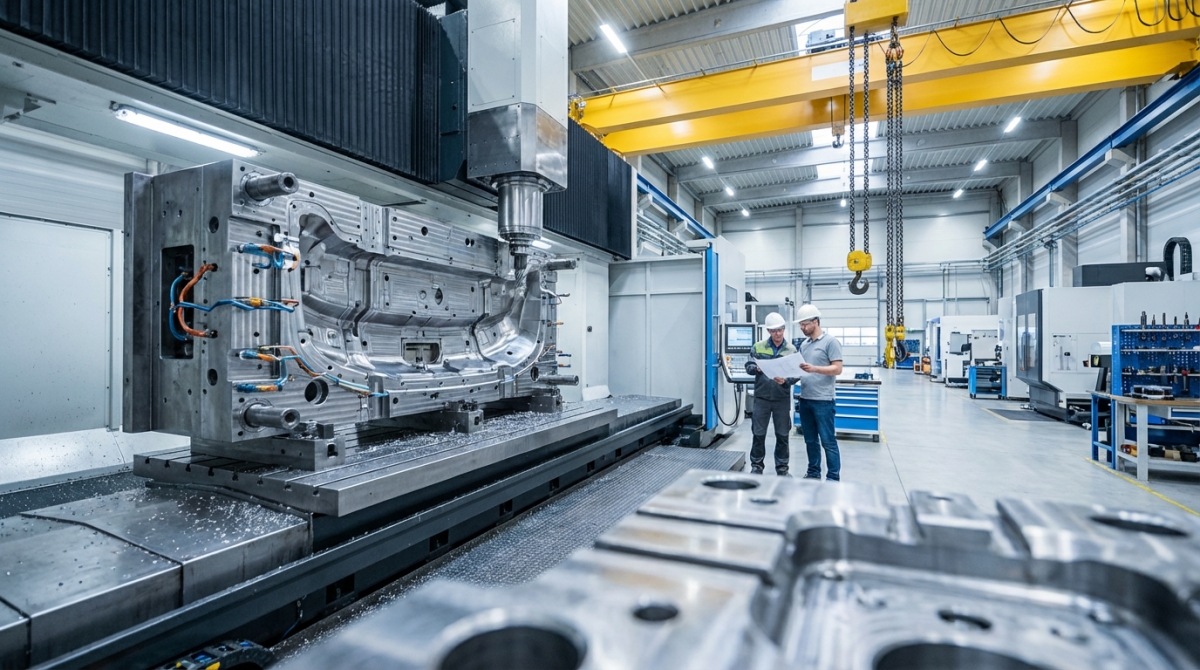
What Qualifies as Large Scale Mold Manufacturing?
- Molds weighing over 10 tons
- Mold lengths exceeding 1.5 meters
- Injection molding machines requiring 1,000 tons to 4,000+ tons of clamping force
- Applications such as automotive bumpers, dashboards, door panels, industrial pallets, and appliance housings
The Stakes Are Higher Than You Think
Unlike small molds, a design or machining error in a large mold can cost:
- Hundreds of thousands of dollars in rework
- 2–3 months of production delay
- Contract penalties in automotive and industrial supply chains
A 20-ton mold cannot rely on “trial and error.” Engineering precision, simulation, and advanced machining are mandatory.
In this comprehensive guide, we will cover:
- How big an injection mold can be
- The major challenges in manufacturing large molds
- Why large mold flow analysis is non-negotiable
- Essential machinery for large mold making
- Steel selection strategies
- Lead time, transportation, and FAQs
At HWPD (Huawei Product Development Industrial Ltd), we combine over 20 years of OEM and mold manufacturing experience to support complex tooling projects from design to mass production.
How Big Can an Injection Mold Be? (Capacity & Limits)
Physical Dimensions: How Big Can an Injection Mold Be?
Modern Large Scale Mold Manufacturing capabilities allow for molds reaching:
- 3–4 meters in length
- Over 2 meters in width
- Weights exceeding 100 tons
Such molds are commonly used for:
- Wind turbine blade components
- Automotive bumpers and instrument panels
- Large waste bins and pallets
- Refrigerator liners and TV rear covers
Projected Area and Clamping Force
The larger the projected surface area of a part, the greater the clamping force required to prevent flash.
- A small 300 mm housing may need 150T
- A car bumper may require 2,000T–3,500T
- Large industrial containers may demand 4,000T+
A flat, wide part requires significantly more clamping force than a compact thick part.
Weight Limits and Handling
Handling molds weighing 50 tons, 80 tons, or 120 tons requires:
- Heavy-duty overhead cranes (20T–100T capacity)
- Reinforced factory flooring
- Specialized mold flipping procedures
- Open-top or flat rack container shipping
Industry Applications
Automotive Industry
- Bumpers
- Instrument panels
- Door modules
- Grilles
Industrial Products
- Pallets
- Crates
- Waste containers
Home Appliances
- Refrigerator liners
- Washing machine tubs
- TV back covers
The Unique Challenges in Manufacturing Large Molds
1. Thermal Control & Cooling (The #1 Challenge)
Maintaining uniform temperature across a 2–3 meter cavity surface is extremely difficult.
Why It Matters
- Warpage occurs
- Shrinkage becomes inconsistent
- Surface finish defects appear
- Cycle time increases
Engineering Solutions
- Conformal cooling channels
- Deep gun-drilled water lines
- Beryllium copper inserts for high-heat zones
- Optimized cooling layout based on Moldflow analysis
2. Structural Integrity & Deformation
A 30-ton mold experiences self-weight sagging, high injection pressure, and clamping compression.
Solutions include:
- Reinforced mold bases
- Strategic support pillars
- Finite Element Analysis (FEA)
- Thick backing plates
3. Surface Finish Consistency
Achieving a Class-A surface finish across a 2-meter automotive bumper is extremely demanding.
- Flow marks
- Weld lines
- Sink marks
- Gloss variation
4. Logistics & Handling
- Heavy-duty cranes
- Dedicated spotting presses
- Specialized transport packaging
- Rust prevention vacuum packing
- Open-top containers
- Flat rack containers
Why Large Mold Flow Analysis is Non-Negotiable
Why Is Large Mold Flow Analysis Important?
On small molds, minor mistakes can be corrected quickly. On a 20-ton mold, “trial and error” is financial suicide.
What Does Mold Flow Analysis Reveal?
- Fill Time & Injection Pressure
- Weld Line Placement
- Warpage Prediction
- Air Traps and Venting
Industry Software: Moldflow, Moldex3D
What Machines Are Used for Large Mold Making?
1. Double-Column Gantry CNC Machines
- 5-axis capability
- Travel distance: 3m x 2m x 1m+
- High structural stability
- Vibration suppression
2. Large Die Spotting Presses
500T+ spotting press for safe alignment and parting line inspection.
3. Deep Hole Drilling Machines
Gun-drilling equipment for 1–2 meter deep cooling lines.
4. Heavy-Duty EDM (Electrical Discharge Machining)
Precision rib and grille machining for large cavities.
Comparison: Standard vs. Large Scale Mold Manufacturing
| Feature |
Standard Mold Manufacturing |
Large Scale Mold Manufacturing |
| Mold Weight |
< 5 Tons |
10 Tons – 100+ Tons |
| Machine Tonnage |
80T – 650T |
1000T – 4000T+ |
| Cooling Design |
Standard water lines |
Complex, long-distance, conformal cooling |
| Handling |
Forklift |
Heavy-duty Overhead Cranes (20T+) |
| Lead Time |
30 – 45 Days |
60 – 120 Days |
| Main Risk |
Dimensional tolerance |
Warpage, Filling issues, Handling safety |
Selecting the Right Steel for Large Molds
Pre-Hardened vs. Annealed Steel
Preferred steels:
Pre-hardened steel reduces cracking and deformation risk.
Core & Cavity Steel Optimization
- NAK80 for high-gloss visible areas
- Standard steel for structural components
FAQ
Q1: What is the typical lead time for a large automotive bumper mold?
Typically 12–16 weeks (T1), depending on complexity and hot runner systems.
Q2: How do you transport a 50-ton mold overseas?
Disassembly, vacuum packing, open-top or flat rack container shipping.
Q3: What tonnage machine is needed for a car dashboard?
Usually between 2500T and 3500T.
Q4: Can large molds be repaired?
Yes, using laser welding or CNC re-machining.
Conclusion: Engineering Giants with Precision
Large Scale Mold Manufacturing combines heavy machinery, advanced simulation, precision machining, and strict QC management.
At HWPD (Huawei Product Development Industrial Ltd), we provide:
- Product design assistance
- Prototyping (CNC, 3D printing, vacuum casting)
- Prototype injection molds
- Large-scale production molds
- In-house mold fabrication with IP protection
Planning a Large Scale Mold Manufacturing Project?
If you are developing automotive, industrial, or large appliance components requiring 1000T–4000T+ injection molding, our engineering team is ready to support you.
- Large mold design consultation
- Mold flow analysis support
- Gantry CNC precision machining
- Structural optimization
- Secure in-house manufacturing
Contact HWPD today to discuss your large scale mold manufacturing requirements.